From Bean to Cup: A No-Nonsense Guide to Making Great Coffee at Home
The specialty coffee world has never been more accessible. Here’s how to bring it home — from choosing the bean to dialling in your brew.
You can make great coffee at home. Genuinely.
This might be the most important thing to say upfront: the gap between café-quality specialty coffee and what you can make in your kitchen has never been smaller. The equipment is better, the knowledge is freely available, the beans are easier to source, and a generation of coffee educators — from James Hoffmann and Lance Hedrick on YouTube to Morgan Eckroth’s handbook Coffee, for Here — have devoted serious effort to making all of it legible to non-professionals. The barrier to a truly excellent cup at home is lower than it has ever been. What it requires is not money, or expertise, or a kitchen full of gadgets. It requires some curiosity and the right priorities.
Priority one: the coffee itself
Every brewer, every recipe, every technique discussed below is secondary to this: the coffee you buy is the single biggest variable in the cup. A mediocre bean, however precisely brewed, will produce a mediocre cup. A great specialty coffee, even brewed imperfectly, will still offer something interesting. Start here before you start anywhere else.
Buy freshly roasted beans. Coffee is an agricultural product with a shelf life. Roasted coffee begins to stale from the moment it leaves the roaster — CO₂ off-gasses, aromatic compounds oxidise, and the cup flattens. Look for a roast date on the bag (not a best-before date). For filter coffee, beans are typically at their best between 7 and 21 days post-roast; for espresso, a little longer — 14 to 30 days — as the reduced CO₂ makes extraction more stable. Avoid anything without a roast date. Avoid supermarket beans unless you know the roaster.
Buy whole beans. Pre-ground coffee stales dramatically faster — surface area exposed to oxygen increases by orders of magnitude when ground. If you can only do one thing on this list, buy whole beans and grind just before brewing.
Source from a specialty roaster. This doesn’t mean expensive, it means intentional. A roastery that lists the farm, the country, the process, and the varietal on the bag is one that cares about what’s inside it. European Coffee Trip maintains a directory of over 6,000 specialty cafés and roasters across Europe — your nearest good roaster is probably closer than you think. Lithuanian readers can start with Huracán, Taste Map, or Kavos Broliai, all of whom sell online.
Store properly. An airtight container, away from light and heat, at room temperature. Do not freeze unless you’re storing for the very long term and doing it right (sealed, in small portions, defrosted without reopening). The fridge is the worst of all worlds — moisture, odours, and repeated temperature changes.
Priority two: the grinder
James Hoffmann puts it plainly: a good grinder “will unlock coffee brewing for you.” It is the piece of equipment that matters most — more than the brewer, more than the kettle, more than anything else. A burr grinder (as opposed to a blade grinder, which chops unevenly) produces a consistent particle size, and consistent particle size is what produces even, predictable extraction.
You don’t need to spend a fortune. At the entry level, the Baratza Encore and the Timemore C3 (a hand grinder) are reliable starting points widely recommended by educators including The Coffee Chronicler. For pour-over, a hand grinder in the £40–80 range will outperform most electric grinders at the same price. For espresso, the demands are higher — espresso requires very fine, very consistent grinding and the grinder budget needs to reflect that.
The principle: spend more on the grinder than the brewer. A £100 grinder paired with a £20 V60 will outperform a £20 grinder paired with a £100 brewer, every time.
Understanding your recipe: ratio, grind, temperature, time
Before diving into brewers, it helps to understand the four levers you’re adjusting every time you make coffee. Lance Hedrick — a former World Brewers Cup competitor and one of YouTube’s most methodical coffee educators — frames home brewing as a process of learning which lever to pull when a cup tastes off.
Ratio (coffee to water) is your starting point. For filter methods, 1:15 to 1:17 by weight is the standard range — 15 to 17 grams of water for every gram of coffee. A 1:15 ratio produces a more concentrated, full-bodied cup; 1:17 is lighter and cleaner. Use a scale. Volume measurements (scoops, tablespoons) are imprecise and inconsistent.
Grind size controls extraction rate. Finer = more surface area = faster extraction = stronger, potentially more bitter. Coarser = less surface area = slower extraction = lighter, potentially more sour. If your cup tastes sour or thin, grind finer. If it tastes harsh or bitter, grind coarser. This is the adjustment you make most often.
Water temperature affects how aggressively compounds are extracted. For lighter roasts, 93–96°C pulls out the delicate aromatics that define them. For darker roasts, slightly cooler water (90–93°C) softens the bitterness. If you don’t have a temperature-controlled kettle, simply letting boiling water sit for 30–60 seconds brings it to the right range for most filter brewing.
Water quality matters more than most people expect. Coffee is roughly 98% water. Tap water with high chlorine content or very high mineral content will affect the cup noticeably. The Coffee Chronicler recommends water between 30–100 TDS (total dissolved solids) for filter coffee. Filtered water or a good bottled mineral water is a simple upgrade that costs almost nothing.
Brew time is your diagnostic tool. If a pour-over drains too quickly (under 2:30 for most recipes), grind finer. Too slowly (over 4 minutes), grind coarser. Time is a symptom, not a target in itself — follow what your cup tastes like, not the clock.
Brewing methods: a practical overview
Rather than prescribe a single method, what follows is a map of the brewing landscape — how different tools produce different results, and what kind of drinker each suits best.
Cone pour-overs: V60 and family
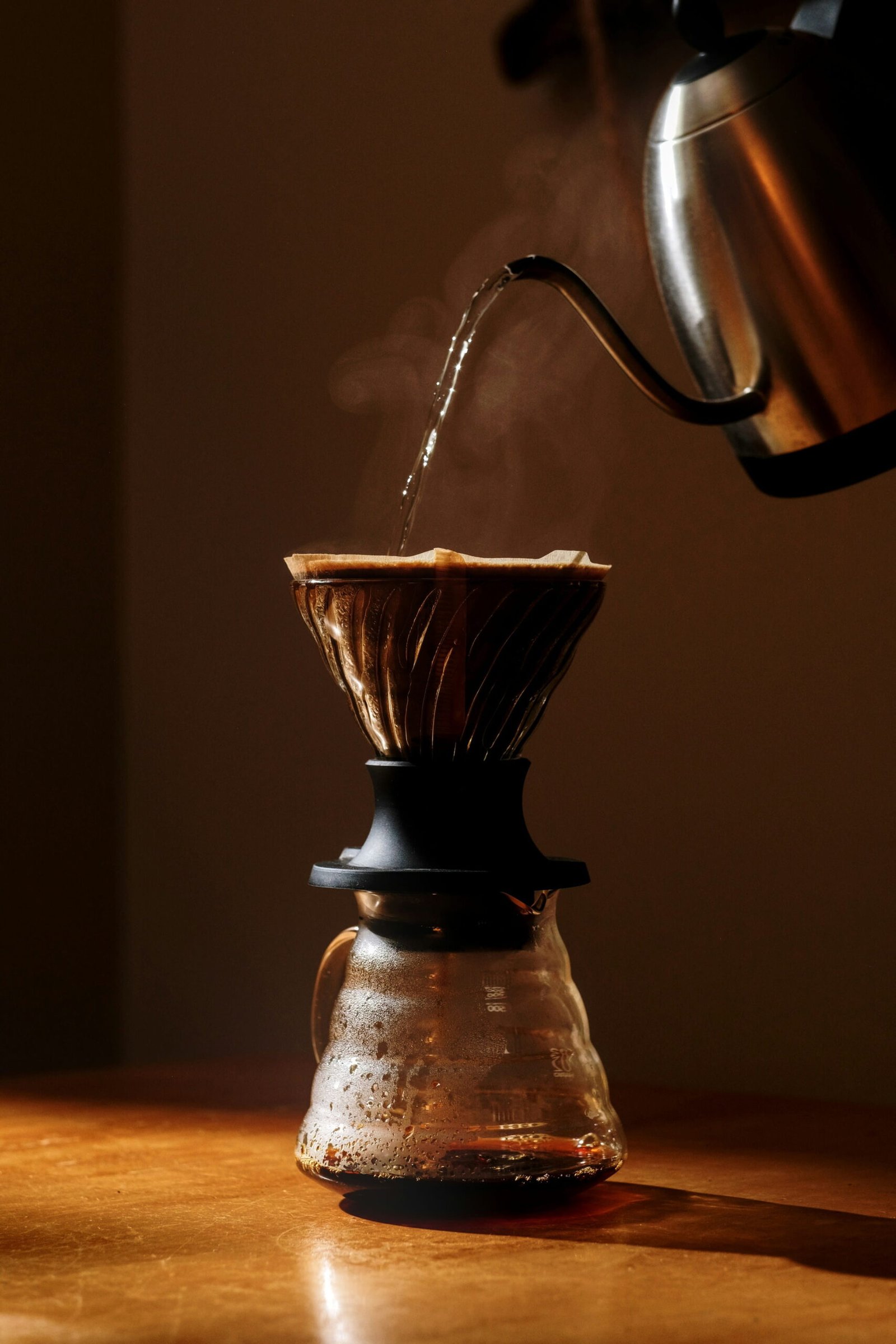
The Hario V60 is the most widely used filter dripper in specialty coffee — used by the majority of World Brewers Cup champions and recommended consistently by Hoffmann, Hedrick, and European Coffee Trip’s brew guides. Its cone shape, spiral ribs, and large single hole give the brewer fine control over flow rate and extraction. The result, when done well, is a clean, bright, expressive cup that lets origin character shine.
The V60 has inspired a whole family of similar drippers: the Kalita Wave (flat-bottom, three small holes — more forgiving, slightly fuller body), the Origami (ceramic, compatible with both flat and conical filters — a favourite in competition), the Orea and April Brewer (newer designs optimised for clarity and even extraction). All operate on the same principle — hot water poured over grounds held in a filter, draining by gravity. Technique matters: a bloom pour (wetting all grounds first and waiting 30–45 seconds for CO₂ to release) followed by steady, controlled pours. Hoffmann’s universal V60 recipe — 30g coffee, 500ml water, single long pour after the bloom — remains one of the most widely used starting points for beginners.
Paper filters produce the cleanest cup; metal filters allow more oils and body through. Neither is wrong — they produce different results.
Immersion: French press, AeroPress, Clever Dripper
Immersion brewing means the coffee grounds steep in water for a set time before being separated — more like brewing tea than pouring water through. The result tends to be fuller-bodied, with more texture and less brightness than pour-over.
The French press is the most forgiving home brewer: coarse grind, 4-minute steep, plunge. Hoffmann’s updated French press method — using a finer grind, longer steep, and skimming the crust before plunging slowly — produces a dramatically cleaner cup than the standard approach. No paper filter means oils pass through, contributing body.
The AeroPress is perhaps the most versatile brewer available. It can produce filter-style coffee or something closer to espresso concentrate; it works with fine or coarse grinds; it brews in under 2 minutes; it’s nearly indestructible. Morgan Eckroth’s Coffee, for Here dedicates significant space to AeroPress recipes precisely because of this flexibility. The World AeroPress Championship has spawned hundreds of published recipes — a rabbit hole worth falling into.
The Clever Dripper combines immersion and filter: grounds steep in the dripper (which has a valve that keeps water in), then the valve opens when placed on a cup and the coffee drains through a paper filter. European Coffee Trip calls it “a top-notch alternative” — clean like a pour-over, forgiving like a French press, ideal for beginners.
Pressure: Moka pot and stovetop methods
The Moka pot (Bialetti Brikka or the original Moka Express, invented 1933) uses steam pressure to push water up through packed grounds — producing a concentrated, intense brew with a syrupy texture. It is not espresso, despite the name “stovetop espresso,” but it occupies a similar flavour space. It suits medium-dark roasts particularly well, and it is deeply embedded in Italian and Lithuanian household culture. Key tips: don’t pack the grounds, use pre-heated water, keep the heat low and the lid open to monitor flow, and remove from heat the moment it begins to gurgle.
Batch brewing: the underrated method
A good automatic drip machine — a batch brewer — is one of specialty coffee’s most underrated tools. Professional-grade batch brewers like the Moccamaster, Fellow Stagg EKG partner, or Ratio Eight brew at the correct temperature, with the correct bloom, and produce 4–8 cups of genuinely excellent coffee with minimal effort. Sprometheus (The Real Sprometheus) has covered batch brewing at length, making the case that for daily home use it consistently outperforms manual methods for most people — less technique dependency, same great bean. If you drink multiple cups a day and find manual methods a chore, a quality batch brewer is a legitimate answer.
Cupping at home: taste like a professional
Cupping is the industry-standard method for evaluating coffee — used by buyers, roasters, and competition judges worldwide. It requires almost no equipment and teaches you more about coffee in one session than months of casual drinking. You don’t need to follow the full SCA protocol; a simplified version works beautifully at home.
What you need: a scale, a burr grinder, a kettle, identically-sized cups or bowls (wide-mouthed mugs work fine), a large spoon, and a timer.
How to do it: Weigh 10–11g of coffee per cup. Grind medium-coarse — coarser than pour-over, as the grounds will steep. Smell the dry grounds first (the “dry fragrance” — you’ll be surprised how much you can already detect). Pour 93–94°C water over all cups simultaneously and start the timer. At 4 minutes, you’ll have a crust of grounds on the surface — use the back of your spoon to break it gently, bringing your nose close to inhale the bloom of aroma. Let the cup cool slightly, then taste by slurping forcefully from a spoon — the aerating slurp sprays coffee across your entire palate and sends aromatics up through the back of your throat.
Taste again as it cools. Acidity, sweetness, and body all shift as temperature drops — a coffee that tastes harsh hot may reveal beautiful fruit notes at 50°C. The SCA Coffee Taster’s Flavor Wheel gives you vocabulary: start broad (fruity, floral, nutty, roasty) and work toward specific terms as your palate develops. Cupping the same coffee side by side from two roasters, or two coffees from the same origin, teaches you more about what you like than any guide can.
A word on espresso at home
Home espresso is its own discipline — rewarding but demanding. Espresso requires very fine, very consistent grinding, precise temperature, and 9 bars of pressure. The grinder is even more critical here than in filter: a £50 grinder will not produce good espresso regardless of what machine it’s paired with.
A realistic entry setup: a Gaggia Classic Pro or Breville Bambino paired with a Timemore Sculptor or Eureka Mignon grinder. Expect a learning curve of several weeks — dialling in espresso (adjusting grind until the shot runs at the right ratio, time, and taste) is a skill that takes practice. Hoffmann’s espresso framework: aim for a ratio of 1:2 to 1:2.5 (1g of coffee yielding 2 to 2.5g of liquid espresso), a brew time of 25–35 seconds, and let your palate guide adjustments rather than the clock. If it tastes sour, grind finer. If bitter, grind coarser.
The Real Sprometheus and his Espresso Anatomy series on YouTube remains one of the best plain-language resources for understanding what’s actually happening inside the portafilter — highly recommended for anyone starting out.
One honest note: if the budget is limited, spend it on the grinder and buy the cheapest machine that has a non-pressurised portafilter. The machine pushes water; the grinder makes the coffee.
The bottom line
The specialty coffee world of 2025 is extraordinarily well-documented, well-taught, and well-equipped. The educators, the tools, and the beans are all there. You do not need a £2,000 espresso machine or a collection of exotic drippers. You need freshly roasted whole beans from a roaster you trust, a decent burr grinder, clean water, and the willingness to pay attention to what’s in the cup. Everything else is refinement — and the refinement, as it turns out, is most of the fun.
People and resources worth following
- James Hoffmann – YouTube and his book The World Atlas of Coffee
- Lance Hedrick – YouTube (pour-over technique, recipes, competitions)
- Morgan Eckroth – 2022 US Barista Champion, book: Coffee, for Here
- The Real Sprometheus – YouTube (espresso anatomy, batch brew, honest reviews)
- The Coffee Chronicler (gear guides, water, filter and espresso deep dives)
- European Coffee Trip – Brew Guides