Matcha • aiya – THE TEA
From a Song Dynasty bowl to your kitchen counter — the complete story of matcha tea, and a guide to one of its most trusted producers.
The leaf that became a ceremony
Matcha is not simply powdered green tea. It is the result of a specific plant, grown under specific conditions, harvested at a precise moment, processed by hand and stone, and prepared according to a tradition that has been practised with almost unchanged intention for eight centuries. That history matters — not as a marketing footnote, but because it explains why matcha tastes the way it does, why it behaves differently from every other tea, and why a shortage of it now sends ripples across menus from Helsinki to Tokyo.
Understanding matcha properly means starting, as with specialty coffee, with the plant itself.
The plant: Camellia sinensis and the logic of shade
All tea — green, black, white, oolong, matcha — comes from a single species: Camellia sinensis, an evergreen shrub native to East Asia. The differences between tea types come not from different plants but from how the leaves are grown, when they are picked, and what happens to them afterwards.
Matcha comes exclusively from Camellia sinensis var. sinensis — the smaller-leafed, more aromatic variety — as opposed to the larger-leafed assamica used in most Indian black teas. But even within sinensis, not all cultivars produce good matcha. The finest matcha comes from cultivars specifically selected for their response to shade: varieties like Samidori, Asahi, Gokou, and Uji-hikari, which develop thin, flat leaves that respond particularly well to the shading process and produce exceptional flavour.
Why shade changes everything
Three to four weeks before harvest, matcha tea gardens are covered — traditionally with reed screens or straw, today more commonly with black shade nets called kanreisha — reducing direct sunlight by up to 90%. This is called hifuku saibai (覆い栽培), or shaded cultivation.
What happens next is the biological key to everything matcha is. Deprived of sunlight, the plant compensates by dramatically increasing its production of chlorophyll — the green pigment responsible for matcha’s vivid, almost neon colour. Simultaneously, the plant produces more L-theanine, an amino acid that creates matcha’s characteristic umami sweetness and, crucially, its calm-alert effect: the combination of caffeine and L-theanine produces focused energy without the jitteriness that caffeine alone causes.
At the same time, the shading process suppresses the production of catechins — the polyphenols responsible for bitterness and astringency in unshaded tea. The result is a leaf that is sweeter, greener, and chemically more complex than any unshaded tea could be.
From leaf to tencha to matcha
Immediately after the harvest of the youngest spring leaves (typically late April to early May), the leaves are steamed — halting oxidation and locking in the vivid green colour and fresh vegetal character. They are then dried, and the stems and veins are removed, leaving only the pure “leaf flesh.” This dried, de-stemmed material is called tencha (碾茶) — the raw material from which matcha is made.
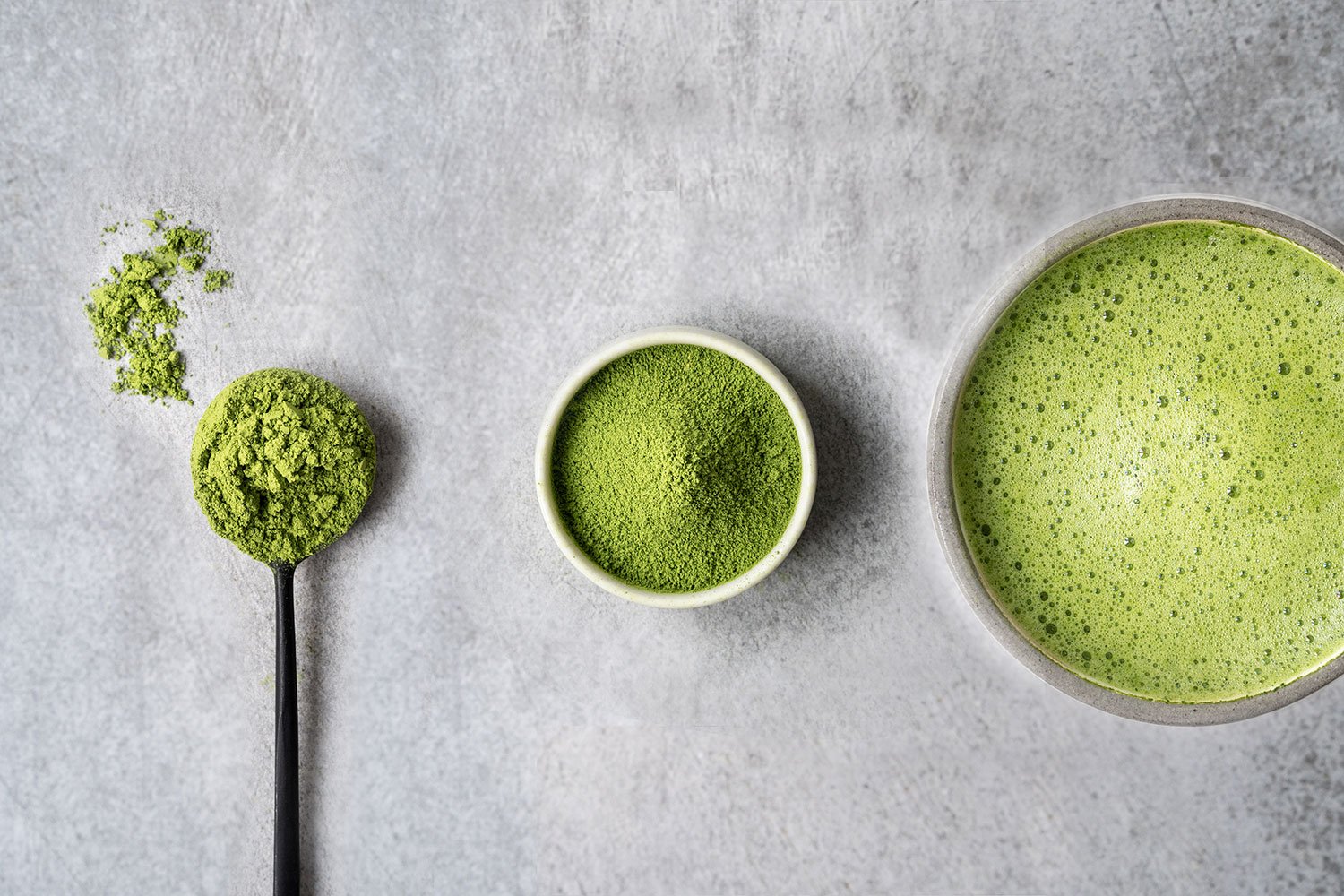
Tencha is then stored in cold rooms until it is ready for milling. The final step is stone grinding: tencha is passed through traditional granite stone mills (ishiusu) at an extremely slow pace — approximately 30–40 grams per hour per mill — which prevents heat buildup that would degrade the delicate aromatics. The result is an ultra-fine powder, around 5–10 microns in particle size, finer than talcum powder. This is matcha.
It is a labour-intensive process at every stage. An entire field, shaded for weeks, harvested by hand at the optimal moment, processed carefully, and stone-milled slowly — which is why genuine quality matcha costs what it does.
A brief history: from Tang Dynasty brick to Zen ceremony
The story of matcha begins not in Japan but in China. During the Tang Dynasty (7th–10th centuries), compressed tea bricks were roasted, ground into powder, and whisked with hot water — a preparation method that spread through scholarly and monastic circles. It was the subsequent Song Dynasty (10th–13th centuries) that elevated this powdered tea ritual into something ceremonial, using a split-bamboo whisk and a wide bowl — the recognisable prototype of the matcha we know today.
In 1191, the Japanese Zen Buddhist monk Eisai returned from his studies in China carrying both tea seeds and the Song method of preparation. He planted the seeds in Kyushu and later at Uji, just south of Kyoto — a region whose misty river valley and cool temperatures proved ideal for tea cultivation. Eisai also wrote Kissa Yōjōki (“Drinking Tea for Health”), Japan’s first tea treatise, in which he described tea as “the most wonderful medicine.”
The ritual that developed around this powdered tea over the following centuries became Chado (茶道) — “the way of tea.” The 15th-century monk Murata Jukō is credited with formalising its philosophical foundations; the Zen Master Sen no Rikyū (1522–1591) refined it into the form still practised today. Rikyū articulated the four principles of Chado: wa (harmony), kei (respect), sei (purity), and jaku (tranquility). These are not decorative concepts — they are expressed in every physical aspect of the ceremony, from the design of the tea room to the movement of the hands.
The tea ceremony: Chado in practice
A formal tea ceremony is an exercise in considered presence. The tea room (chashitsu) is typically small — Rikyū’s original was the size of two tatami mats — and entered through a low door that requires guests to bow, equalising host and guest regardless of social rank. The room contains a tokonoma (alcove) with a hanging scroll and seasonal flowers, changed for each ceremony.
The host’s movements follow a precise choreography developed over centuries. Each utensil is handled according to protocol; each gesture has a name and a correct form. The ceremony is simultaneously a meditation and a hospitality — a performance of care for another person through the making of a bowl of tea.
The essential utensils (chadōgu)
Chawan (茶碗) — the tea bowl. The most important object in the ceremony, chosen seasonally and handled with deliberate care. Wide-mouthed bowls are preferred for winter (retaining heat), shallower bowls for summer (cooling faster). A good chawan is considered an object of significant aesthetic value — some historical examples are designated national treasures.
Chasen (茶筅) — the bamboo whisk. Made from a single piece of bamboo, split into fine tines — traditionally 80 tines for ceremonial matcha, 16 for thicker preparations. Making a chasen takes years of apprenticeship; the craft is concentrated in Takayama, Nara Prefecture, where a small number of families have produced them for over 500 years. A chasen lasts roughly 3–6 months with regular use before the tines begin to split.
Chashaku (茶杓) — the bamboo tea scoop. Hand-carved, used to measure matcha from the caddy to the bowl. Often inscribed with a poetic name by the maker.
Natsume (棗) — the tea caddy. A rounded lacquered container for storing usucha (thin tea) matcha during the ceremony. Named for its resemblance to the jujube fruit.
Fukusa (袱紗) — a folded silk cloth used to ritually cleanse the utensils. The folding and unfolding of the fukusa is among the most complex physical elements of the ceremony.
For home preparation, the minimum equipment needed is a chawan, a chasen, a chashaku, and a fine-mesh sieve — the latter to break up any clumps before whisking. Everything else is optional refinement.
Grades and quality: what you’re actually buying
The terms “ceremonial grade” and “culinary grade” are widely used in the matcha market — and widely misunderstood. Japan does not have a formal grading system using these terms. They are marketing conventions developed largely for Western markets. What actually determines matcha quality is: the harvest number (first harvest = youngest, sweetest leaves), the cultivar, the region, the degree of shading, the milling precision, and the freshness.
Ceremonial grade uses only the youngest first-harvest leaves, shaded for the full period, from the finest cultivars. The colour is vivid, almost electric green. The taste is dominated by umami sweetness with little or no bitterness — designed to be drunk pure, whisked with water alone at 70–80°C.
Premium grade balances ceremonial character with slightly more assertiveness — suitable for daily drinking pure or in a well-made latte with quality milk. This is the sweet spot for most matcha enthusiasts.
Culinary (or cooking) grade uses later harvests and less intensively shaded leaves. The colour is more olive-green, the flavour more bitter and robust. In baking, ice cream, confectionery, or blended drinks with strong flavours, the assertiveness of culinary grade holds up where ceremonial grade would disappear.
Japanese growing regions and their terroir
Uji (Kyoto) is considered the historical home of Japanese matcha. The Uji River creates morning mist that naturally shades the tea plants, reducing bitterness and boosting L-theanine. Uji matcha is known for layered depth, complexity, and prestige.
Nishio (Aichi) produces around 20% of Japan’s tencha from a tight community of dedicated growers, with over 90% of the area’s fields committed exclusively to matcha production. Nishio matcha is known for balanced sweetness, mild bitterness, and clean finish.
Kagoshima is now the largest matcha-producing prefecture by volume, accounting for roughly 40% of Japan’s total tencha output. Volcanic soils rich in minerals produce a bright, fresh, approachable matcha — lower in bitterness, gently sweet, clean.
How to prepare matcha: the essentials
Water temperature: 70–80°C for ceremonial and premium grades. Never boiling — high temperatures destroy the delicate aromatics and amplify bitterness. Let boiled water sit for 5–10 minutes.
Sieving: Pass 1–2g of matcha through a fine-mesh sieve into the bowl before adding water. This breaks up clumps and makes whisking dramatically easier.
Whisking: Add 60–80ml of water. Whisk with the chasen in a rapid “W” or “M” zigzag motion — not circular — until a fine, uniform foam develops on the surface. This takes 15–20 seconds.
Usucha vs. koicha: Usucha (thin tea) uses 1–2g of matcha and 60–80ml of water — the standard preparation. Koicha (thick tea) uses 3–4g and only 30–40ml of water, producing a thick, concentrated preparation that requires premium or super-premium matcha.
Matcha latte: Whisk 1–2g of matcha with 30–40ml of warm water first to create a concentrate, then add 150ml of steamed or cold milk. Do not skip the pre-whisking step.
Iced matcha: Whisk matcha with a small amount of warm water, then pour over ice and cold milk. The brief warm-water contact properly dissolves the powder.
Trends in Europe: matcha in 2026
Matcha arrived in European consciousness as a health food and a café drink — the matcha latte became a fixture of specialty coffee menus from around 2018 onwards. In 2026, the picture is more nuanced and more interesting.
Ceremonial-grade matcha drunk pure is growing as a practice among people who want the ritual, the calm focus, and the flavour without the additions. This mirrors what happened in specialty coffee: the progression from milk-based drinks toward appreciating the base ingredient itself.
Hojicha is the single biggest emerging trend. Google Trends data shows global interest in hojicha up 54.6% since early 2025, with “hojicha latte” searches up 173%. Perfect Daily Grind described it in February 2026 as “the next matcha” — and the logic is sound. It offers the ritual of a powdered Japanese tea, a lower caffeine content that suits afternoon and evening consumption, and a flavour profile — roasted, nutty, chocolatey — that is immediately accessible to anyone who drinks coffee.
The shortage: what is happening and why it matters
The global matcha market roughly tripled in production between 2010 and 2023, driven by social media — particularly TikTok matcha latte content that created an enormous new consumer base in the US and Western Europe. Japan’s tencha producers, whose farms take 5 years from planting to first commercial harvest, could not expand fast enough to meet it.
Then, in 2024, record-breaking heatwaves hit Kyoto and Aichi during the critical spring shading window — damaging tencha quality and reducing harvestable volume. The 2024–2025 shortage was the most severe in recent history. Tencha prices increased by up to 220% in 2025 — the largest price increase in the history of matcha.
The structural problems compound the weather. The average Japanese tea farmer is 65 years old. Between 2000 and 2020, four out of five tea producers exited the industry. New planting takes five years to produce a commercial crop.
Industry forecasts point to late 2026 or early 2027 as a possible stabilisation point. In the meantime: if you find good matcha from a trusted producer at a fair price, buy it. Store it correctly — cool, dark, airtight, away from strong odours. AIYA’s direct relationship with its own farms and long-term partner growers in Kagoshima provides more supply security than many smaller brands during a period of supply constraint.
AIYA — Matcha masters since 1888
In 1888, a man named Aijiro Sugita opened a small store in Nishio, Aichi Prefecture, selling two things: tea and indigo dye for kimono fabrics. His nickname — Aiya — was borrowed from his trademark dye ingredient, Aidama. It became the name of the company. More than 130 years later, AIYA is the largest matcha producer in Japan, and one of the most trusted names in the global specialty matcha market.
The milestones of AIYA’s history read like a timeline of matcha’s industrialisation and internationalisation — achieved without abandoning the method. In 1912, AIYA owned exclusive rights to 35 hectares of tea fields. By 1990, the company operated 1,080 granite stone mills. In 1992, it developed a production line reducing microbial count without chemical treatment. In 1999, it became the first matcha company to receive ISO 9002 certification. In 2002, it became the first internationally certified organic matcha producer.
AIYA’s consumer brand, aiya — THE TEA, launched in Europe in 2009. All consumer products are certified organic (AT-BIO-301), sourced from AIYA’s own farms and partner farms in Kagoshima Prefecture — where the volcanic soils of Kyūshū island, enriched by eleven active volcanoes and a humid subtropical climate, have produced tea for around 700 years.
The granite stone mills still run at the same deliberate pace. AIYA’s matcha is still ground by the same method Aijiro Sugita used in the 19th century — slowly, without heat, preserving the aromatics that faster industrial milling destroys. That continuity is not sentiment. It is the reason the matcha tastes the way it does.
AIYA product guide: which one, and when
1. Everyday Organic Matcha Izumi
“Izumi” means “source” in Japanese.
The entry point to the AIYA range — and a genuinely honest one. Izumi is stronger and slightly more bitter than the grades above it, with a more assertive vegetal character. Use it for cooking and baking, for matcha blended into smoothies or fruit, or as your everyday morning cup when you want the energy and ritual of matcha without overthinking the cup. It is also the right place to start if you are new to matcha.
Best for: beginners, baking, smoothies, everyday drinking.
2. Ceremonial Organic Matcha Akashi
“Akashi” means “glow” in Japanese — a reference to its bright green colour.
AIYA’s most popular product and the one most customers return to. Akashi has a rich aroma with fruity notes and combines all the qualities that define good ceremonial matcha: mild, delicately bitter at the entry, smooth, sweet, and clean on the finish. It is ceremonial quality at an accessible price, making it the right daily cup for someone who has moved past the entry-level tier and wants to drink matcha pure, whisked in a bowl.
Best for: daily ceremonial preparation, matcha lattes with quality milk, confident beginners.
3. Premium Organic Matcha Horai
“Horai” refers to the mythological Japanese island of the blissful.
The pride of AIYA’s organic farmers — a rare, premium quality with a bright emerald green colour, deep sweetness, and a finish that is very smooth, very mild, and almost entirely free of bitterness. Horai is fine enough to prepare as koicha (濃茶) — thick tea, made with very little water and a high dose of matcha, producing a dense, intensely flavoured concentrate.
Best for: pure ceremonial drinking, koicha preparation, moments that deserve attention.
4. Super Premium Organic Matcha Ten
“Ten” (天) means “heaven” in Japanese.
A limited edition, and the pinnacle of the AIYA consumer range. Ten has a sweet, mild, light, fruity, and intensely aromatic profile — the kind of matcha where the colour alone, a ravishing bright jade green, signals what is about to happen in the cup.
AIYA recommends drinking Ten pure, as koicha, undiluted by milk or sweetener. Use this for ceremony. Use this when the cup is the point.
Best for: ceremonial practice, gifting, moments of genuine deliberate pleasure.
5. Organic Hojicha Roasted Matcha
Something entirely different. Hojicha (ほうじ茶) is traditionally made by roasting green tea leaves over charcoal until they turn reddish-brown and develop a complex roasted character. AIYA’s version takes ceremonial-grade stencha, grinds it, and then gently roasts it — producing a powdered hojicha that can be whisked like matcha but tastes nothing like it.
The flavour profile: dark chocolate at the entry, soft cocoa mid-palate, warm nutty tones, a gentle smokiness. The cup colour is a rich amber-brown rather than green. Crucially, the roasting process dramatically reduces caffeine content — making this the right choice for evenings, for people sensitive to caffeine, or for anyone who wants the ritual without the stimulation.
Best for: evening drinking, caffeine-sensitive drinkers, hojicha lattes, cocktails.