From Green to Gold: Everything You Need to Know About Coffee Roasting
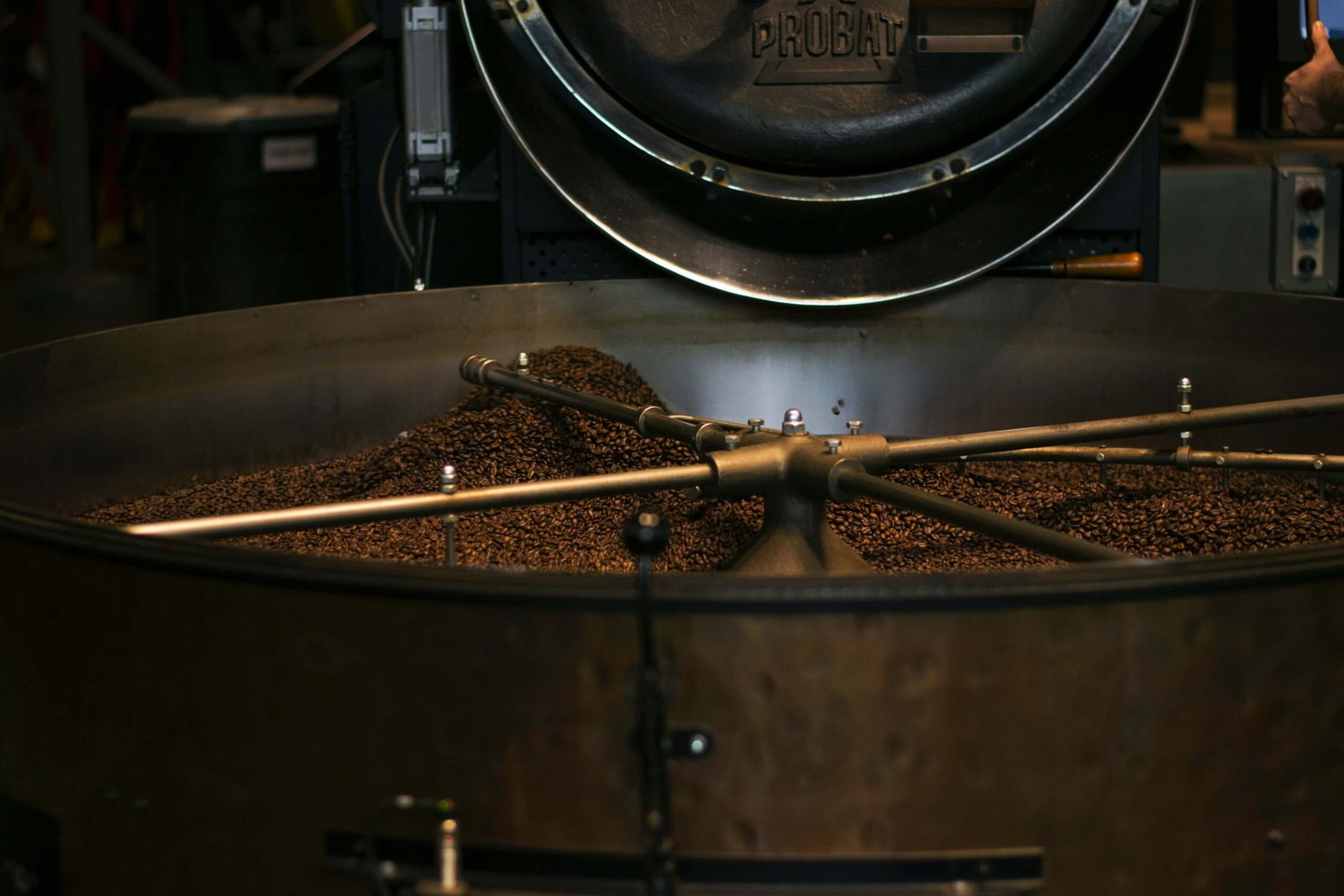
From green seed to aromatic cup — a deep dive into the science, craft, and culture of coffee roasting, with a look at Lithuania’s world-class roasting scene.
What is coffee roasting?
A green coffee bean is, in itself, almost nothing like what ends up in your cup. It smells faintly grassy, tastes astringent and raw, and contains a dense lattice of sugars, amino acids, lipids, chlorogenic acids, and water — the raw ingredients of something extraordinary, but not yet that thing. Roasting is the process of applying precisely controlled heat to transform those compounds into the hundreds of aromatic molecules that define coffee as we know it. It is simultaneously a manufacturing process, a scientific discipline, and, in the hands of a skilled roaster, a form of craft.
The roaster’s job is not simply to apply heat until a bean turns brown. It is to navigate a complex, time-sensitive series of chemical and physical changes — coaxing out what is best in a given coffee while avoiding the defects that poor technique introduces. Done well, roasting is an act of translation: taking what a farmer grew at altitude and revealing it in the cup.
What happens inside the bean: the chemistry and physics
Roasting unfolds in three broad phases, each with distinct chemistry.
Phase one: drying
Green beans contain between 8–12% moisture. Before any browning reactions can begin, that water must be driven off. In the drying phase, the bean absorbs heat endothermically — the temperature of the bean lags behind the roasting environment as energy goes into evaporating moisture rather than driving chemical change. The bean yellows and begins to smell of fresh bread and hay.
Phase two: the Maillard reaction and caramelisation
As the bean’s internal temperature climbs past roughly 150°C, the most consequential chemistry begins. The Maillard reaction — a cascade of interactions between amino acids and reducing sugars first described by French chemist Louis-Camille Maillard in 1912 — begins generating hundreds of new aromatic compounds. These include pyrazines (nutty, roasted), furans (caramel, sweet), aldehydes (fruity, floral), and melanoidins (the brown pigments that give roasted coffee its colour and body). By some estimates, nearly 70% of coffee’s aromatic complexity originates here.
Alongside the Maillard reaction, caramelisation — the thermal degradation of sugars independent of amino acids — intensifies above roughly 170°C, producing toffee, chocolate, and brown-sugar notes. These two reactions are often confused but are chemically distinct: the Maillard reaction requires both amino acids and sugars; caramelisation requires only sugars and heat.
Chlorogenic acids — powerful antioxidants present in green coffee — break down during this phase, reducing bitterness and astringency while releasing further aromatic compounds. The longer and more aggressively this phase runs, the more of those delicate origin-driven flavours are replaced by roast-driven ones.
Phase three: first crack and development
As CO₂ builds inside the bean and cell walls weaken, the coffee reaches first crack — an audible popping sound, similar to popcorn, as the bean fractures and expands. Volume increases by 50–80%. The bean transitions from endothermic (absorbing heat) to exothermic (generating it), meaning the roast can now accelerate of its own accord if the roaster is not attentive. The time spent after first crack — called development time — is one of the most critical variables in determining final flavour. Too short and the coffee tastes underdeveloped, grassy, or sour; too long and it becomes flat, baked, or ashy.
A second crack, at higher temperatures, signals the breakdown of the bean’s cellular structure, producing the oily surface and bold, bitter characteristics of dark roasts. Many specialty roasters stop well before this point.
Roasting styles and flavour profiles
There is no universal roasting style — and no objective “correct” one. Flavour preference is cultural, personal, and contextual. That said, a few broad schools of thought define the modern landscape.
Light roast
Stopped shortly after first crack, light roasts preserve the greatest amount of origin character — the terroir, the varietal, the processing method. Expect high acidity, bright citrus or berry fruit, floral notes, and a lighter body. The bean retains more moisture and more of its original sugars, resulting in a more complex but also more demanding cup. Light roasts are the signature of the Nordic/Scandinavian school, which emerged in the early 2000s and has profoundly shaped specialty coffee globally, including in the Baltics. The philosophy: minimise the roast’s influence and let the farmer’s work speak.
Medium roast
Developed further past first crack, medium roasts balance origin character with roast character. Acidity softens, sweetness deepens, and body increases. Caramel, milk chocolate, and stone fruit notes are common. This is the most broadly accessible profile — and the most common in quality-focused espresso programmes, where a degree of body and sweetness helps the coffee integrate with milk.
Dark roast
Extended development pushes the coffee toward and past second crack. Origin character is largely replaced by roast character: bittersweet chocolate, smoke, char, low acidity. The bean loses mass and gains surface oils. Dark roasts were the dominant style globally through most of the 20th century, shaped by Italian espresso tradition and commercial coffee culture. In specialty circles, very dark roasts have fallen out of favour — the argument being that heavy roasting masks the quality and provenance of the bean rather than expressing it.
Nordic/Scandinavian style
A distinct subset of light roasting defined by fast, hot profiles with very short development times — designed to highlight brightness, sweetness, and fruit while avoiding any “roasty” quality in the cup. This style has been enormously influential across Northern and Eastern Europe, including Lithuania, where it sits alongside the older Italian espresso tradition in a productive tension.
Roasting machines: the tools of the trade
The roasting machine fundamentally determines how heat reaches the bean — and the type of machine shapes the flavour outcome as much as the roaster’s decisions about temperature and time.
Drum roasters
The dominant machine type in specialty coffee. A rotating steel drum tumbles the beans through a combination of conductive heat (from the drum surface), convective heat (from hot airflow through the drum), and radiant heat. Classic manufacturers include Probat (Germany, founded 1868 — the industry’s most storied name), Giesen (Netherlands), Diedrich (USA), and Has Garanti (Turkey). Drum roasters offer a slow-start, fast-finish heat transfer profile — forgiving, consistent, and excellent for developing body and complexity.
Air/fluid-bed roasters
Rather than a drum, fluid-bed roasters suspend beans in a column of hot air — pure convective heat transfer. The original design was developed by Michael Sivetz in the 1970s. Modern examples include Loring (USA), known for its sealed-system design that dramatically reduces emissions and fuel consumption. Air roasters roast faster and tend to produce cleaner, brighter flavour profiles — though the lack of conductive heat means achieving body and sweetness requires careful technique. Roest (Norway) has brought fluid-bed technology to the sample and home roasting market, favoured by specialty buyers cupping lots at origin.
Sample roasters
Small-batch machines — typically 50–200g capacity — used by green coffee buyers and roasters to evaluate lots before committing to full purchases. Probat BRZ, Ikawa (a precision electric sample roaster with app-controlled profiles), and the Roest are the most common. Scott Rao and other consultants have done extensive work comparing sample roasters to production machines to ensure profile consistency.
Home roasters
Popcorn-style air roasters, small drum machines like the Kaldi or Behmor, and purpose-built units like the Aillio Bullet (a cult favourite among home enthusiasts for its data logging and precision control) have made home roasting an accessible hobby. James Hoffmann has explored home roasting extensively on his YouTube channel, documenting experiments with green bean sourcing and profile development.
The thinkers who shaped modern roasting
Scott Rao is, by most accounts, the most influential figure in contemporary specialty roasting methodology. His 2014 book The Coffee Roaster’s Companion became the definitive technical reference for the industry — the first systematic treatment of roasting science written for practitioners rather than chemists. His follow-up, Coffee Roasting: Best Practices (2019), refined the methodology further, focusing on advanced curve control, rate-of-rise management, and avoiding common defects like baked coffee and ROR crashes. Rao also developed the concept of Rate of Rise (RoR) as the primary diagnostic tool for evaluating and controlling a roast in real time — now standard across the industry.
James Hoffmann, 2007 World Barista Champion and author of The World Atlas of Coffee, has done more than perhaps anyone to translate specialty coffee knowledge — including roasting — into accessible language for consumers and enthusiasts. His YouTube channel, with millions of subscribers, regularly explores roasting science: from the question of whether dark roasts are inherently inferior to careful experiments on degassing and freshness.
On the scientific side, researcher Christopher Feran and food scientist Dr. Samo Smrke have advanced the understanding of roasting chemistry, while Cropster and Artisan software have made real-time roasting data analysis standard practice in professional roasteries worldwide.
The World Coffee Roasting Championship
The World Coffee Roasting Championship (WCRC), held under the World Coffee Championships umbrella, tests competitors on their ability to evaluate green coffee, develop a roast profile, and produce a finished roast judged on physical analysis, sensory quality, and consistency. It is the most rigorous public test of a roaster’s complete skill set.
At the 2024 WCRC in Copenhagen, Taiyang Liu of China took the title, with Mateusz Derkacz of Poland in second — a strong Baltic-adjacent result. The 2025 WCRC in Houston was won by Mikaël Portannier of France, with Taiwan’s Ashton Huang in second. The championship has increasingly reflected the globalisation of specialty roasting, with China, Taiwan, and Southeast Asian competitors regularly challenging the traditional dominance of European and Antipodean roasters.
Coffee roasting in Lithuania
For a country of fewer than three million people, Lithuania punches well above its weight in coffee roasting — both in the volume of roasters operating and in the international recognition they have earned.
Huracán Coffee, founded by Vytautas Kratulis in Vilnius in the mid-1990s, is the oldest and most internationally decorated. Kratulis helped organise Lithuania’s first barista championship in 2003, and his roastery has never stopped reaching outward. In 2025, Huracán was crowned the winner of the Global Coffee Awards World Championship — recognised for exceptional Filter and Flat White Alternative coffees — cementing Lithuania’s place on the global roasting map. Huracán sources carefully, roasts with precision, and distributes internationally. Their website now carries the subtitle “World’s Best Coffee Roaster 2025.”
Taste Map Coffee Roasters, founded in 2011 by Domas Ivonis and Ieva Malijauskaitė, brought a more educational philosophy to Lithuanian roasting. Their four-location Vilnius operation includes a dedicated sensory room for cupping sessions and coffee education — a rare amenity that signals their commitment to helping consumers understand what they’re drinking, not just selling it to them. The roastery uses Daterra (Brazil) as a key direct-trade partner and rotates seasonal single-origin lots across its cafés.
Kavos Broliai (Coffee Brothers), roasting since 2017, takes a science-first approach to sourcing: green coffee from small, non-commercial farms, light and sweet roast profiles, and meticulous quality control. As the roasting partner behind Espresinė in Žvėrynas — awarded Best Roastery in Lithuania by the Falstaff Coffee Guide Nordics 2026 — they represent perhaps the purest expression of the Nordic influence on Lithuanian roasting culture.
Vero Coffee House, headquartered in Kaunas and now operating over 37 locations across the Baltics, occupies a different space: a quality-driven chain rather than a boutique roastery, but one that won the Lithuania National Winner title at the Global Coffee Awards Europe — proof that scale and quality are not mutually exclusive.
Around 30 roasteries now operate across Lithuania, with the majority in Vilnius but a growing number in Kaunas, Klaipėda, and smaller cities. The scene is heavily influenced by Scandinavian light-roast philosophy filtered through an Italian espresso heritage — a combination that produces some of the most interesting and idiosyncratic cups in the region. As international names like Kāvlē and Rocket Bean open Vilnius outposts, the city is increasingly a place where roasters come to compete, not just to sell.
Further reading
- Scott Rao – Coffee Roasting: Best Practices
- Scott Rao – The Coffee Roaster’s Companion
- James Hoffmann – The World Atlas of Coffee
- World Coffee Roasting Championship – WCC
- Perfect Daily Grind – Drum vs. fluid bed roasters
- Perfect Daily Grind – Specialty coffee is maturing in the Baltics (2026)
- Huracán Coffee – World’s Best Coffee Roaster 2025